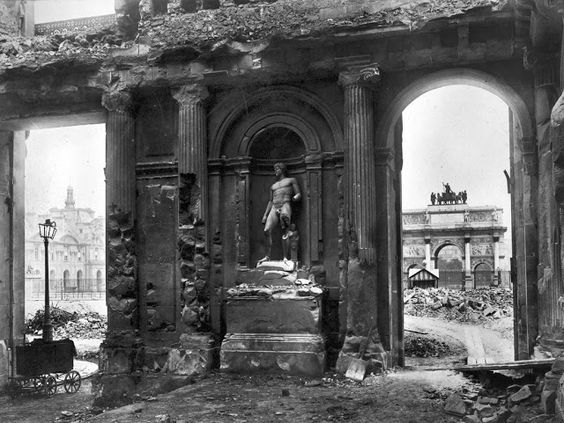
A silence of death reigned over these ruins…No clatter of vehicles, no shouts of the children, not even the song of a bird…An incredible sadness invaded our souls.
— Théophile Gautier
Manet looks at Civil War
In 1872, rubble and debris could be seen all over Paris. Only a year after the disastrous Franco-Prussian war and subsequent civil war, the economy was a wreck. The city would remain a vast construction site for the rest of the decade.
Ruins of the Tuileries Palace, 1871
Because the recent events were so emotionally devastating, most French artists avoided those awful days as subject matter. But not Édouard Manet.
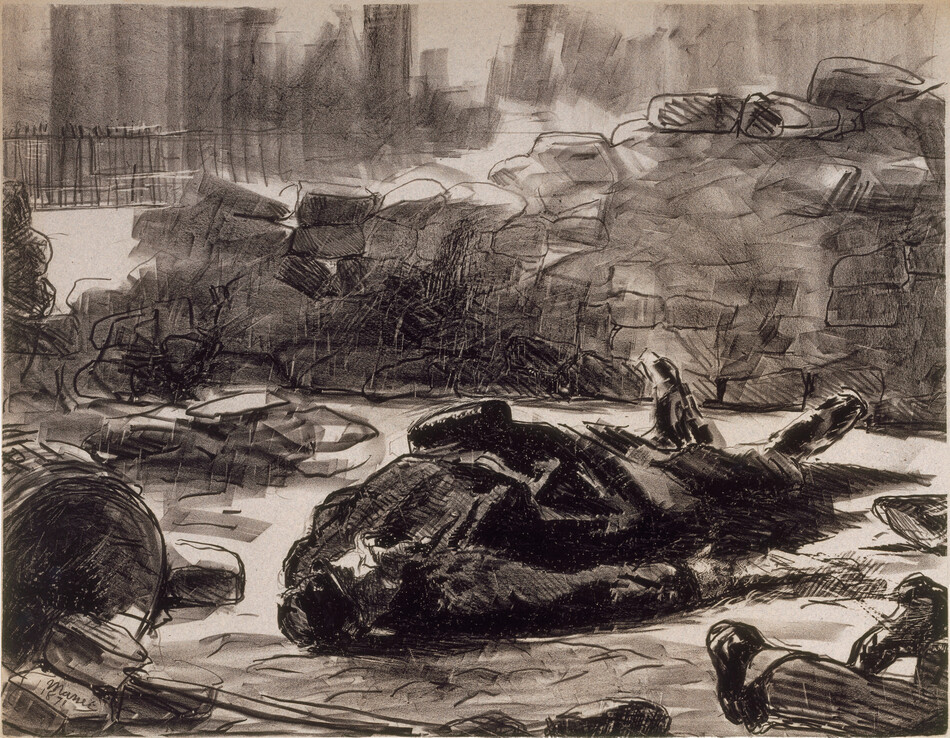
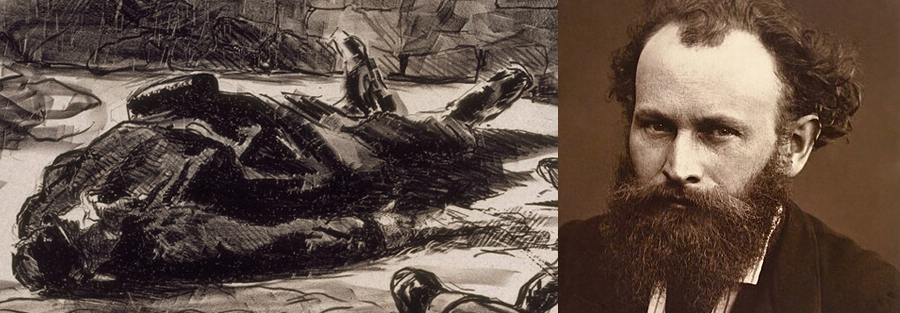
Manet, Civil War (Scene from the Commune of Paris) , 1871.
Inspired by Goya’s suite of etchings, The Disasters of War (from the early 1800s), Manet documented the suffering of the Parisians during their Terrible Year. His lithograph, Civil War (Scene from the Commune of Paris) was based on sketches he made in the grim aftermath of a battle against federal forces in late May 1871. We can see at the center a dead, heroic Communard behind a stone barricade. In the lower right corner are the legs of a civilian victim.
“…every war is worse than expected.” – Paul Fussell
During the Franco-Prussian war everyone in Paris, whether painter, poet, or plumber, was swept up by history. Even after the abdication of Napoleon III and the birth of the new Republic that Édouard Manet and his fellow Impressionists had long dreamt of, the armies of the “Government of Defense” continued to suffer defeat after humiliating defeat across French territory. By the autumn of 1870, there seemed little hope of stopping Prussian forces in their relentless drive towards Paris.
The Siege
As bad news continued to flood in, many Parisians – if they had the means – fled from the city. Monet, who had a military exemption purchased by his father, headed north — crossing the Channel to London. There he was joined by Camille and their son where a small artists community of exiles was forming. Pissarro (who was technically a Danish citizen) came with his family, then Sisley, Daubigny, and their art dealer Durand-Ruel. Cezanne headed in the opposite direction — home to the south of France — to avoid being drafted.
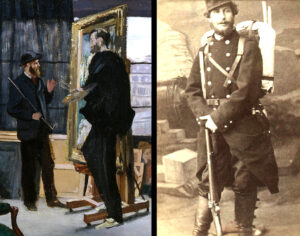
1870 Paris: Manet (left) in Bazille’s studio/Bazille in uniform
Manet and Degas, however, stayed to defend their city. Partisans of the new French Republic like so many of their friends, they enlisted in the National Guard. Renoir joined the cavalry. Rodin was drafted but later dismissed because he was too nearsighted. Gauguin served in the French navy in a group that captured four German ships. Frédéric Bazille, a close friend of Monet and Renoir, was killed leading an assault on the Prussians 65 miles south of Paris. Corot, in his 70s, refused to leave his studio and donated huge sums to the poor of Paris. Courbet, Gustave Moreau, Fantin-Latour, and Daumier also remained. Berthe Morisot, who could have spent the war far from the fighting with her sister in Normandy, insisted on staying with her parents in the city’s affluent neighborhood of Passy.
As the Prussians drew closer, the battered, retreating French armies, along with farmers from the countryside, poured into Paris. The population of the capital grew rapidly – just as the new Republican government was struggling to figure out how to feed a city about to be cut off from the outside world.
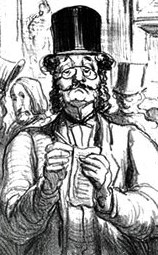
detail of Honoré Daumier’s The Influential Critic, 1865
Be careful when you insult an artist. You may be making art history.
Art criticism is probably as old as art itself and often comes in harsh tones. Plato was no friend of artists, describing them as tricksters and called for their banishment from his Republic. Yet more than once a critic’s insult has ended up naming an art movement.
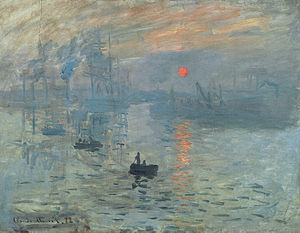
In 1874, Louis Leroy wrote about an exhibition of a group of artists that included Monet, Pissarro, Degas, and Renoir, who called themselvesLeSociété anonyme. In a mocking tone, Leroy said of Monet’s Impression: Sunrise,
Impression; I was certain of it. I was just thinking that as I was impressed, there had to be some impression in it. And what freedom! What ease of handling! A preliminary drawing for a wallpaper pattern is more highly finished than this landscape!
Claude Monet, Impression:Sunrise, 1872
At the end of the review, Leroy pretends he saw a mad admirer dancing around the painting, singing ““Hi-ho! I am impression on the march, the avenging palette knife…”
The article was called “The Exhibition of the Impressionists.” The name stuck.