“…every war is worse than expected.” – Paul Fussell
During the Franco-Prussian war everyone in Paris, whether painter, poet, or plumber, was swept up by history. Even after the abdication of Napoleon III and the birth of the new Republic that Édouard Manet and his fellow Impressionists had long dreamt of, the armies of the “Government of Defense” continued to suffer defeat after humiliating defeat across French territory. By the autumn of 1870, there seemed little hope of stopping Prussian forces in their relentless drive towards Paris.
The Siege
As bad news continued to flood in, many Parisians – if they had the means – fled from the city. Monet, who had a military exemption purchased by his father, headed north — crossing the Channel to London. There he was joined by Camille and their son where a small artists community of exiles was forming. Pissarro (who was technically a Danish citizen) came with his family, then Sisley, Daubigny, and their art dealer Durand-Ruel. Cezanne headed in the opposite direction — home to the south of France — to avoid being drafted.
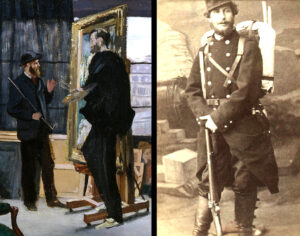
1870 Paris: Manet (left) in Bazille’s studio/Bazille in uniform
Manet and Degas, however, stayed to defend their city. Partisans of the new French Republic like so many of their friends, they enlisted in the National Guard. Renoir joined the cavalry. Rodin was drafted but later dismissed because he was too nearsighted. Gauguin served in the French navy in a group that captured four German ships. Frédéric Bazille, a close friend of Monet and Renoir, was killed leading an assault on the Prussians 65 miles south of Paris. Corot, in his 70s, refused to leave his studio and donated huge sums to the poor of Paris. Courbet, Gustave Moreau, Fantin-Latour, and Daumier also remained. Berthe Morisot, who could have spent the war far from the fighting with her sister in Normandy, insisted on staying with her parents in the city’s affluent neighborhood of Passy.
As the Prussians drew closer, the battered, retreating French armies, along with farmers from the countryside, poured into Paris. The population of the capital grew rapidly – just as the new Republican government was struggling to figure out how to feed a city about to be cut off from the outside world.